

Saturday, January 19, 2008
"Happy Birthday Janis Joplin"

"Groove Yard: Rockridge, CA shop sustains LP life even after MP3 success"

from sfgate.com - by David Rubien
Everyone knows the story of how the compact disc overthrew the 12-inch vinyl record album. It's a done deal, right? The LP put up a fight for a while, and even 10 years ago you could find collectors and audiophile die-hards pawing the stray used-record bin. But they're not getting any younger, and even hip-hop DJ scratching ain't what it used to be.
The vinyl emporiums are mostly gone - Revolver, the Magic Flute, Saturn, Brown's ... even the mighty LP stalwart Village Music of Mill Valley cashed it in last year.
But hold the phone.
Now it looks as if the dominance of the CD may be a tad overrated. The discs have only been around 26 years, and already they're being tossed aside in favor of digital downloading. According to Nielsen SoundScan, sales of CDs dipped 20 percent since 2006, and downloads of individual songs are up 54 percent.
As a result, those dusty LPs are starting to appear a bit more shiny. Certainly Rick Ballard, owner of Groove Yard records, thinks so.
"This has been a very good year for me," says Ballard, 59, but looking 15 years younger. His little store on Claremont Avenue in the Rockridge section of Oakland could fit into a single aisle of Amoeba Music in Berkeley or San Francisco. But unlike his vinyl-peddling colleagues who threw in the towel, Ballard has stayed focused and patient, and as a result his operation has blossomed like a desert flower in the parched landscape of on-premises music retail.
"I really made it a strategy to focus on vinyl, because I really think we're at the beginning of the slow death of CDs," Ballard says. "I talk to regulars who come in here who have teenage kids. ... All their kids just download. They'll never even own a CD, probably."
Ballard carries all kinds of LPs - and some CDs as well - but his specialty is jazz, a niche genre whose niche keeps shrinking. "The major labels, as far as I can tell, are almost completely out of the jazz business," Ballard says. Yet, he adds, "The demand for jazz LPs has really held up. I had three different sets of Japanese buyers in here last week alone, none of whom looked at CDs."
Walking into the Groove Yard, you're immediately struck with the sensory experience that's unique to the used-record store. First that dusty, somehow comforting aroma of used cardboard hits your nostrils, after which you tune into the jazz song playing on the stereo. Then come the visual delights: album covers from the 1950s through the '70s adorning the walls - bold, often kitschy and dated images of musicians and/or their instruments, sometimes strange and alluring abstract paintings, and titles printed in fonts meant to attract and seduce.
Less than half the size of an LP, a CD just can't deliver that kind of visual impact. And in the world of iTunes, it's almost completely eliminated.
"The 12-inch LP, and to a lesser degree the 10-inch LP, made album art relevant," Ballard says. "I mean, you can look at a history of American graphics in album cover art. ... You can have the greatest CD cover in the world, but it's still small. It's not gonna grab you on a visual level like an album does."
Needless to say, an LP is mainly about its music, and much has been written about the superiority or inferiority of a record's analog sound, as opposed to a CD's digital. To audiophiles, there's no contest. As for MP3s - forget about it.
But it's probably safe to say that sound quality is not the main reason people look for jazz LPs. Neither is it because the records are investments that will appreciate significantly in value. The most expensive jazz album at Groove Yard is a 1971 private pressing by flutist Lloyd McNeill - "Washington Suite" - for $350. The most expensive album Ballard ever sold was "House of Blue Lights" by '50s bebop pianist Eddie Costa - $700. For the most part, Groove Yard LPs sell for between $6 and $10.
The real value of these LPs is something greater than the sum of their parts. They are historical documents, windows to a slice of culture that is neglected even as it's paid lip service as America's great contribution to music. These albums tell stories of popular culture, high art, technology, marketing, drugs and race.
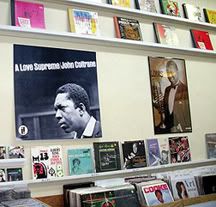
Just pulling a few examples out of Groove Yard's bins, there are:
-- Bassist Charles Mingus' "Black Saint and the Sinner Lady" from 1963 for $45. One of the great jazz geniuses, Mingus was a deeply frustrated, angry individual who railed against racial injustice before it became acceptable to do so in the '60s. Instead of being showered with grants and commissions as he deserved, he was evicted from his apartment.
-- The Chet Baker Quartet, "Jazz at Ann Arbor" ($35) - a cool and handsome trumpeter, he was marketed as a white alternative to Miles Davis, yet like so many other jazz artists, he couldn't resist the lure of heroin, which brought him down.
-- Miles Davis, "Miles Ahead," a 1957 release with the original album cover that Miles demanded Columbia change. "Miles made them withdraw the cover because he said he didn't want the cover with the white woman," Ballard says. That's ironic, because Davis was famously color-blind when it came to choosing band mates.
The beautiful thing about Groove Yard is that no prior knowledge of any of this stuff is necessary, because a walking, talking encyclopedia is always in the house. That's Ballard.
"It's really more than a store; it's a conversation center," says Herb Wong, the jazz educator, producer, prolific liner notes writer and former DJ at the late KJAZ who is a frequent visitor to the Groove Yard. "Rick is not just a merchant, he's someone who brings a set of values to his merchandise. He has a very easy grasp of the relationship between different vintages and ensembles. So it's much more rewarding to be at his store and have the chance to rap with him."
Ballard got into the record business as a distributor. Anyone of a certain age who was interested in cutting-edge jazz of the '70s and '80s probably has a few records adorned with a little gold sticker reading "Distributed by Rick Ballard Imports."
Ballard, who grew up in Oakland, was a record store clerk with a degree in psychology from UC Berkeley in 1971 when he became curious about some of the music he read about in European and Canadian jazz magazines - music that wasn't available in the States. So he wrote to a couple of labels asking if he could order records. They wrote back.
"They knew that I worked in a record store, so they asked me if I'd be interested in importing their records and being a distributor," Ballard says. "I had always wanted to run my own business. So I took $250 and sent it to the guy in Paris, and he sent me 100 records. I sent another $250 to a guy in Munich. That company was ECM. They had just issued their first Keith Jarrett record, which was 'Facing You.'
"I got in my car, drove over to (former Berkeley record store) Leopold's and they bought everything I had right on the spot. I took the money, sent it back overseas and got more records."
He eventually became the West Coast distributor for several labels, including Black Saint, Hat Hut, India Navigation, Unit Core, with artists like Cecil Taylor, David Murray, Don Pullen, Chick Corea, Anthony Braxton and dozens more - most of them brilliant U.S. artists who couldn't get record deals back home. And he sold to dozens of stores in the West Coast and later nationwide.
When CDs began to become the dominant music format in the late '80s, Ballard found himself stuck with a warehouse full of more than 20,000 LPs. He decided to try to sell them directly to the public, so he sectioned off part of his warehouse in Jack London Square, and the Groove Yard was born in 1987. Then he began purchasing used records from the public in order to round out his inventory.
Four years later he moved the store to 48th and Telegraph avenues in Oakland, and in 2002 he arrived at the current location, which had previously housed Berrigan's, another great record store.
Ballard still salts and peppers his bins with the old imported product from his warehouse, some of which fetch top dollar. But as a retailer he's become a jazz expert, and he's learned the intricacies of the used-record market, what to pay and what to charge. He also dons his distributor shoes now and then, shipping jazz CDs by local artists like singers Sony Holland and Jenna Mammina to stores in Japan. "The Japanese are crazy for piano trio and female vocalists," Ballard says. That's about the extent of his CD business.
With Amoeba Music - not to mention eBay - out there swallowing up so much used product, Ballard has to be on his game. Part of that involves spreading the jazz gospel via a monthly newsletter he e-mails to about 2,200 people. Sprinkled with Ballard's extremely dry wit, the newsletter keeps customers abreast of product that's arrived in the store, recommends what jazz shows to see, hosts ticket giveaways, and mentions special jazz events and radio schedules.
None of this is making Ballard rich, but he's a happy man, living his little corner of the jazz life.
"It's a sound that really feels good to my ears," he says. "I love other styles of music... but nothing does it for me like jazz does."
Groove Yard Jazz LPs/CDs:
5555 Claremont Ave.
Oakland, CA
Open 11 a.m.-6 p.m. Mon.-Sat.
noon-5 p.m. Sun.
(510) 655-8400
myspace.com/grooveyardjazz
Friday, January 18, 2008
"Sean Paul's Reggae Music gives woman seizures"

GARDEN CITY, N.Y. (AP) - Now that surgeons have operated on Stacey Gayle's brain, her favorite musician no longer makes her ill. Four years after being diagnosed with epilepsy, Gayle recently underwent brain surgery at Long Island Jewish Medical Center to cure a rare condition known as musicogenic epilepsy.
Gayle, a 25-year-old customer service employee at a bank in Alberta, Canada, was suffering as many as 10 grand mal seizures a day, despite being treated with medications designed to control them. The condition became so bad she eventually had to quit her job and leave the church choir where she sang.
Eighteen months ago, she began to suspect that music by reggae and hip-hop artist Sean Paul was triggering some of her seizures. She recalled being at a barbecue and collapsing when the Jamaican rapper's music started playing, and then remembered having a previous seizure when she heard his music.
Her suspicions were confirmed on a visit to the Long Island medical center last February, when she played Paul's hit "Temperature" on her iPod for doctors. Soon after, she suffered three seizures.
"Being that the seizures could be triggered by the music, this was a very interesting opportunity to study Stacey's brain," said Dr. Ashesh Mehta, the hospital's director of epilepsy surgery.
During the first surgery, doctors implanted more than 100 electrodes in the right side of her brain to pinpoint the abnormal area of her brain.
The surgeons followed that procedure with a second surgery to remove the electrodes, along with parts of her brain suspected of causing the seizures.
"We used the latest techniques, including image guidance, to pinpoint the areas of abnormality, and the operating microscope to perform the procedure during a four-hour operation," Mehta said.
Within three days, the woman was released from the hospital and has not experienced a seizure since.
"I always live each day like it's my last," she said. "I want to show others that life does not end at epilepsy. I know I have what it takes to succeed."
Thursday, January 17, 2008
"JAMAICA: 7" Vinyl has been eliminated"

In Jamaica, seven-inch singles are completely extinct; DJs have ditched their turntables. Will the digital revolution mean the end of traditional reggae? Dave Stelfox
Reggae's already had one digital revolution. On the night of February 23, 1985, at a packed venue on Waltham Park Road in Kingston, Jamaica, the producer Lloyd "Prince Jammy" James used a soundclash against the Black Scorpio Sound System to unleash the song that changed Jamaican music forever. Wayne Smith's Under Mi Sleng Teng was based on a stripped-down Casio keyboard loop, with a thunderous computerised bassline. It was the first wholly electronic reggae recording, and its distinctive rhythm marked the birth of the style that came to be known as dancehall.
Now Jamaican music is in the midst of a second, further-reaching technological revolution. This time it's not how reggae sounds that's being turned inside out, but how it's being consumed. In a strange anachronism, reggae has long offered groundbreaking music - its experimental impulses explored through roots, dancehall and dub - but for the past two decades that music has been dependent for exposure on what, in most of the rest of the world, is considered the preserve of collectors only: the seven-inch single. For years Jamaica has been the world's most prolific manufacturer of vinyl, with antiquated pressing plants working full tilt to keep up with the warp-speed productivity of Kingston's studio system. However, over the past year fans have noticed a startling drop in the availability of new music on hard-copy formats.
"The reduction in vinyl production in the West Indies has dramatically affected the way I access music," explains the legendary DJ - or selector - David Rodigan, host of the weekly Rodigan's Reggae show on London's Kiss 100 FM. "In a nutshell, vinyl has been eliminated by the people who play the music to the public. The key players - and by that I mean the sound system selectors that people go to see every weekend, who can make or break a song - are no longer dealing with it in any shape or form and have all switched to CD. Now if someone wants to send me a song, they just email it to me as an MP3. This process has been gradual, but it's now absolute."
The slump in vinyl releases actually turns out to be more or less irrelevant to the industry's health on home turf. As Rodigan says: "The domestic Jamaican market for singles has been negligible for quite some time. Turntables are no longer available there and the home audience buys sound system mixtapes and DVDs of live shows and dances instead. Then there's the matter of piracy, meaning that people can now purchase burned CDRs of new music on the streets at a fraction of the price that legitimate releases would command. It's a reflection of the economic realities in Jamaica that the emotional motivations of overseas collectors have for years propped up vinyl manufacture. Particularly in Europe, people still want to own reggae in that form because it helps them connect to the music's original roots and culture. Now that's coming to an end, though."
A better gauge of the health of reggae, however, is the demise of another phenomenon specific to Jamaican music. After recording a new backing track, reggae producers have traditionally asked several different singers to record their own vocal interpretations of the tune - so each could be released, and the producer would be able to make as much money as possible out of each studio session. That process, known as "voicing", was then followed by each version being released as a separate single. The more popular the instrumental proved, the more songs were cut. With each new production averaging around 20 different versions, labels such as London's Greensleeves and New York's VP Records began to collect these songs on individual "riddim albums", a signature format that became pivotal to reggae's international infrastructure - until now.
Dan Kuster, Greensleeves' head of A&R, says things are changing fast. "We've scaled back our release of dancehall riddim albums because they don't sell any more," he says. "Reggae is in a period of transition and the way people consume music has undergone huge shifts lately. It used to be that producers cut test pressings of new music to give to sound systems and radio DJs, then, if the songs received a good reaction, they'd be released as proper singles. Now, with everyone playing from CD, it's much easier and quicker for people to burn a copy of their work and pass it directly to the guy they want to play it.
"It's got to the point that when producers say that a song has been released in Jamaica, they don't actually mean that it's been pressed. They just mean that it's being played. In fact, a vast amount of music never sees a conventional release at all now. While seven-inches have mainly been an export business since the early 1990s, they still functioned as a valuable barometer of a tune's popularity and were difficult to duplicate, too. Now, as soon as a song is in someone's hands it can be copied and sold in Jamaica in days and, thanks to peer-to-peer platforms and certain pirate websites I'd rather not name, all over the rest of the world in a matter of hours. By the time we get to put a riddim album out, everyone has it already, so it's not worthwhile. Also, while the older people who listen to roots reggae may still want to own music, dancehall is pop music with a young audience that, typically, just wants to be able to hear it and is not concerned with being able to hold the actual record."
That is a problem faced by record companies around the world, but its impact on reggae is more immediate. There's no legitimate domestic market - and increasingly there's no international market, either, thanks to illegal downloads. But in Jamaica, it's not the artists who are suffering.
When voicing a riddim, artists are usually paid a flat fee by producers, not royalties, regardless of how well their song sells. Instead they make their fortunes from live performances and the recording of dubplates - custom versions of big hits calling out the name of a specific selector or sound system that are then played at dances or competitive sound clashes. The more in demand the artist or song, the more these dubplates cost, and with professional DJ teams around the world hungry for exclusive tracks, it's a lucrative trade for top-tier performers. It is, in fact, the producers who are finding themselves cut out of reggae's economic loop.
"The people behind the scenes are the ones who are really feeling it," says Jeremy Harding, head of Kingston's 2 Hard record label. "The artists aren't noticing any change at all. They can still get paid well for performing and cutting dubs, but Jamaican producers have always been responsible for generating their own income. It's not like hip-hop, where someone like Timbaland is paid thousands of dollars for a beat. We actually pay people to feature on our music. For a long time producers made their money from singles sales and overseas licensing if a tune got big, but the riddim albums really kept the scene afloat. Now that's finished, people don't know what to do."
Kuster is cautiously optimistic, and takes a pragmatic view of the downturn in Jamaican musical production. "No one wants see this industry in decline," he says. "But the one good thing is that the days of ridiculous amounts of versions of mediocre rhythm tracks are at an end. No one needs 20 versions of one tune because, of those 20 songs, people probably only ever wanted to hear five or six anyway. Now, with fewer voicings being made, a lot of substandard material has been cut out. The way ahead now is to concentrate on the value of individual songs and place emphasis on quality over quantity."
Harding agrees, likening the forces bearing down on reggae to those of natural selection. However, he also sees opportunities for growth. "To get by, people are going to have to be smart," he says. "They will have to take a longer-term view and this can be done by paying attention to things like artist development." As the manager of dancehall superstar Sean Paul and a number of rising producers, including Craig "Leftside" Parks, he speaks with authority. "From now on, we will see music makers looking into alternative revenue streams, investing more heavily in individual performers, building ongoing relationships with them, and crossing over into management roles."
Should any music be able to weather such a storm, it's reggae. If nothing else, its largely informal economy allows it to adapt much faster than the major labels in the US or Europe. In fact, as Harding points out, attitudes and expectations are already beginning to alter on the island. "People are starting to think differently. They're realising that they can't rely on easy money any more and taking steps to change the way they work," he continues. "Whatever happens, though, reggae and dancehall will never go away. This is our culture so, as long as new generations of artists keep coming through and people want to dance to it, it will always have a future."
Wednesday, January 16, 2008
"Rolling Stones, Scorsese to open Berlin film festival"

The picture, "Shine A Light", features two shows by the veteran rockers in New York in 2006 and guest appearances by Jack White of the White Stripes, pop princess Christina Aguilera and blues legend Buddy Guy.
"Scorsese assembled an award-winning camera team to capture the raw energy of the world's greatest rock'n'roll band," the festival said in a statement.
Scorsese, who scooped up a long-awaited best director Oscar at last year's Academy Awards for "The Departed", used 16 cameras to compile more than half a million feet (150,000 metres) of footage of the band.
"Shine A Light," which will be screening out of competition, also features rare archive footage and catches the band's candid banter backstage.
"Scorsese has created an extraordinary musical film event and given audiences unprecedented access to the Rolling Stones both onstage and off," the festival said.
The Berlinale, which ranks among Europe's top three film festivals, runs February 7 to 17.
Scorsese has developed a series of music-based documentaries including the 2005 Bob Dylan film "No Direction Home" and an upcoming movie on the life of the late Beatle George Harrison.
The director is reportedly also teaming up with Stones frontman Mick Jagger to make a feature film.
The Hollywood trade press has said Jagger will finance the picture titled "The Long Play", which follows the lives of two friends in the rock world from the 1960s until today.
"George Michael signs big book deal"

HarperCollins says the book, currently untitled, will be an "access all areas" story, with the 44-year-old Michael writing extensively about his professional and personal life.
A publishing official with knowledge of the negotiations said the deal was worth at least $6 million for British rights alone, among the biggest publishing contracts ever for that market, and at least $7 million overall.
"George has promised HarperCollins a no-holds barred biography, and it's certain to be just that," the singer's manager, Andy Stephens, said in a statement Wednesday. "People aren't stupid, they're beginning to notice that the truth is more interesting than the stories the press come up with!"
Michael, whose many hits include "Careless Whisper," "Faith" and "Father Figure," has had several run-ins with the law, on charges ranging from drug possession to lewd conduct. Elton John, with whom Michael has performed on stage, has spoken of a "deep-rooted unhappiness" in the singer's life.
"Cocaine Killed Ike Turner, Coroner Says"

from aol.com
The San Diego County medical examiner's office lists the cause of Ike Turner's death as "cocaine toxicity." The rock 'n' roll pioneer, who readily admitted he used drugs during his five decade-spanning career, died in December at age 76.
Subscribe to:
Posts (Atom)

